

You did not fail at willpower.
Many households now carry a pile of recurring charges that arrive on different dates, through different payment methods, with different cancellation rules. A lot of those charges are designed to be easy to start and easy to overlook once they stop delivering value. That is not a character flaw. It is a product and business-model problem, and it is the root of subscription fatigue.
Quick Answer: How Do You Fix Subscription Fatigue?
Treat it as a visibility problem, not a discipline problem. In three steps:
List every recurring charge from the last 12 months of statements.
Test each one: did anyone use it in the last 30 days, and what real problem appears if it disappears?
Cancel or pause what fails the test, and make the renewals you keep visible.
The first pass usually takes under an hour. The goal is not zero subscriptions. The goal is that every remaining charge can answer one question: does this reduce friction more than it creates?
Why Subscriptions Are Designed to Be Easy to Ignore
Most subscription products are built around three things: low friction at signup, automatic renewal, and higher friction at cancellation.
Free trials convert to paid plans with a single click. Billing dates are staggered, so the monthly total never shows up in one place. Cancelling can mean logging into a rarely used account, clicking through several screens, or contacting support. Some services still ask you to confirm by chat or phone.
This follows the incentives. Recurring revenue is more predictable than one-time sales, and a charge that goes unnoticed for longer looks better on a company's numbers. When a company talks about "retention," it can mean you are still paying, which is not always the same as you are still getting value. (That last part is my read of the incentives, not something every company would agree with.)
The pattern in households is familiar:
You subscribe for a specific show, a short project, or a free trial.
Life gets busy.
The charge continues.
Months later you notice the total and feel guilty for "not being disciplined enough."
Guilt is the wrong response. The system makes the charge easy to ignore.
What Subscription Fatigue Actually Costs

Estimates of how many subscriptions the typical person has, and what they spend, vary a lot depending on what a survey counts: streaming, software, delivery, cloud storage, app-store charges, family apps. The pattern I see is more consistent than the numbers: most people are surprised by their real total when they finally add it up.
The cost is not only money:
Decision load every time a new "must-have" tool appears
Mental inventory of which service holds which files, shows, or family data
Time spent hunting for cancellation pages or disputing charges
Low-grade irritation at realizing another $12.99 left the account for something no one opened this month
For families the load multiplies. One adult's work tools, another adult's streaming preferences, kids' educational apps, and shared cloud storage rarely live in a single dashboard. The bill arrives as a series of small hits instead of one clear number.
Useful is not the same as impressive. A service that looked essential at signup can become pure friction once the novelty wears off.
How to Do a Subscription Audit in One Hour
You don't need a complicated spreadsheet or a new budgeting app. You need visibility and a decision rule.
Step 1: Gather Every Recurring Charge (30–45 Minutes)
Open your bank and credit-card statements for the last 12 months, not just the last 60 to 90 days. Annual plans only show up once a year, and they are the ones most likely to renew unnoticed.
Search statements for "subscription," "recurring," "renewal," and the names of platforms you already know.
Check the subscription lists inside your Apple, Google, and Amazon accounts, plus any digital-wallet history.
Search your email for "receipt," "your subscription," and "renews on."
Write down each charge, the amount, the billing date, and who in the household actually uses it. Include free trials that are about to convert.
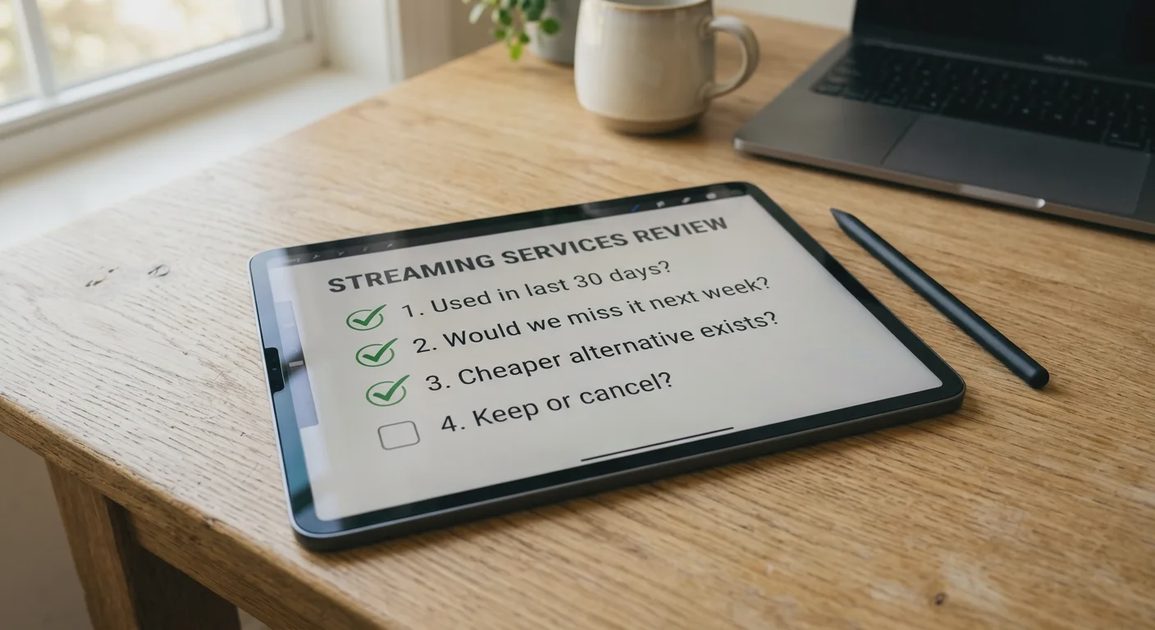
Step 2: Apply the 30-Day Usefulness Test
For each item, ask three questions:
Did anyone in the household actively use this in the last 30 days?
If we canceled it tomorrow, what concrete problem would appear in the next week?
Is there a cheaper or free way to solve the same problem with tools we already have?
If the first two answers are weak and the third is yes, it's a candidate for cancellation.
Step 3: Decide With a Simple Rule
Keep the service if it clearly earns its place: regular use, a function that's hard to replace, or a price that still feels fair once you see the total.
Cancel or pause everything else. Many services offer a pause option that is less painful than full cancellation and still stops the charge.
Before you cancel anything that stores your files, photos, or playlists, export your data first. Cancelling a cloud service without a backup is the one way this audit can make life worse.
Step 4: Make the Next Renewal Visible
Set a calendar reminder 7 to 10 days before major renewals. Or move the few subscriptions you keep onto a single payment method that you review monthly. Visibility beats willpower.
Later reviews take far less time than the first one.
When a Subscription Is Worth Keeping
An audit isn't a purge. Some subscriptions clearly earn their place:
You use it every week and would notice within days if it vanished.
It replaces something more expensive, like a tool your work depends on.
A family plan is cheaper than the separate accounts it replaces.
Two trade-offs are worth knowing. Cancelling and re-subscribing later can mean a higher price, and cancelling a shared family plan affects everyone on it. Check with the household before you cut.
Design and Policy Fixes That Would Actually Help
Individual audits help, but the bigger problem is structural. Better defaults would include:
A one-page cancellation flow that doesn't require support chat
A single dashboard showing all active subscriptions tied to an email or payment method
Annual cost displayed at signup, not just the monthly number
Easy pause options that don't hide the cancel button
Data export, so leaving doesn't mean losing years of files or playlists
Until those defaults are widespread, households have to create their own visibility. That's extra work, and it's fair to be annoyed that the work exists.
Who Needs This Audit (and Who Can Skip It)
This approach is for you if you:
Feel a low-level dread when the credit-card statement arrives
Share devices and accounts with family members
Signed up for more than a handful of trials or "limited-time" offers in the past year
Want technology that stays in the background instead of demanding ongoing management
You can keep a lighter process if you already review every recurring charge monthly and can name the value of each one without hesitation. In that case, the system is already working for you.
Make the Technology Earn Its Place
Subscription fatigue isn't proof that you lack discipline. It's evidence that too many products were designed to collect ongoing payment with minimal ongoing usefulness.
Run the audit. Keep what still earns its place. Cancel the rest without apology. Then protect the calm you just created by treating every new free trial as a temporary experiment with a hard end date.
Technology should reduce friction, not create another monthly decision you have to manage. When a subscription stops doing that job, it no longer belongs in the stack.