Late at night the phone is low and you are already in bed. You plug in the standard iPhone charging cable and two familiar frictions appear at once: the straight lightning cable digs into your palm, and the short length keeps you pinned near the edge of the mattress because the outlet sits behind the nightstand.
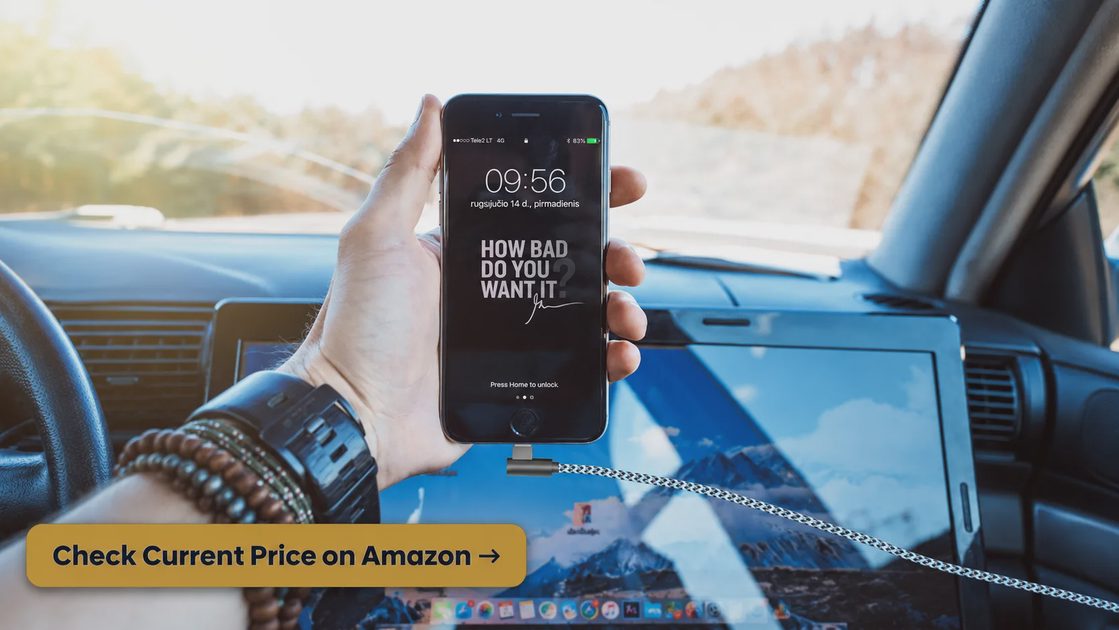
A 10ft 90 degree lightning cable changes both problems at the same time. The right-angle connector lets the cable drop along your hand instead of pressing against it, and the extra length reaches the middle of the bed without pulling tight.
This article looks at where that combination actually reduces daily friction, what the MFi certification and three-pack price realistically deliver, and where the limits on charging speed still remain.
Check Current Price on Amazon →
How a 90 Degree Lightning Cable Changes the Stress on the Connector
A standard straight Lightning cable works fine on a flat desk where pulling forces remain largely axial. On a bed or sofa, however, the connector spends most of its life under unnatural bending pressure.
Whenever the phone rests against a pillow, blanket, or your chest, the device's downward weight transfers directly onto the straight plug sticking out of the bottom. This subjects the joint to repeated bending stress. Over a few Months of ordinary bedtime use, that mechanical fatigue is what opens the fragile plastic neck on an original Apple cable, eventually exposing the metal shielding underneath.
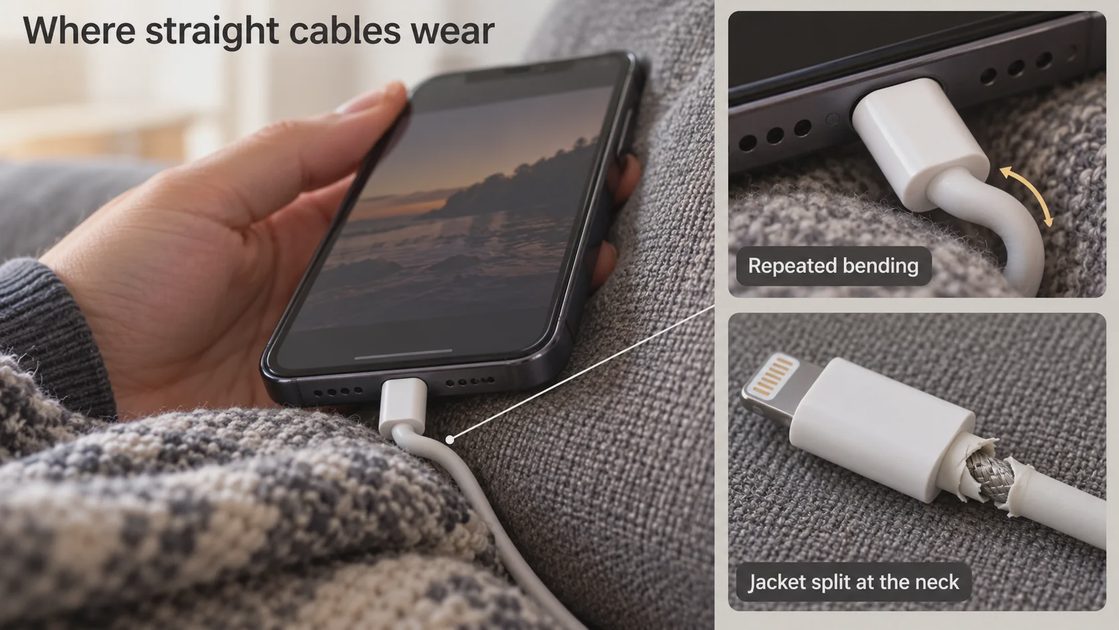
The cable stops fighting the way you actually hold the phone.
What You Actually Get in This 3 Pack 10ft MFi Certified Lightning Cable
The set is a three-pack of 10-foot nylon-braided Lightning cables with a right-angle connector on the phone end. They are MFi-certified. Current pricing is typically around $9.99 for the three, or a little over three dollars each.
You get:
Three long cables
Three colors
MFi certification that prevents the “this accessory may not be supported” warning
USB-A on the charger end (no wall charger included)
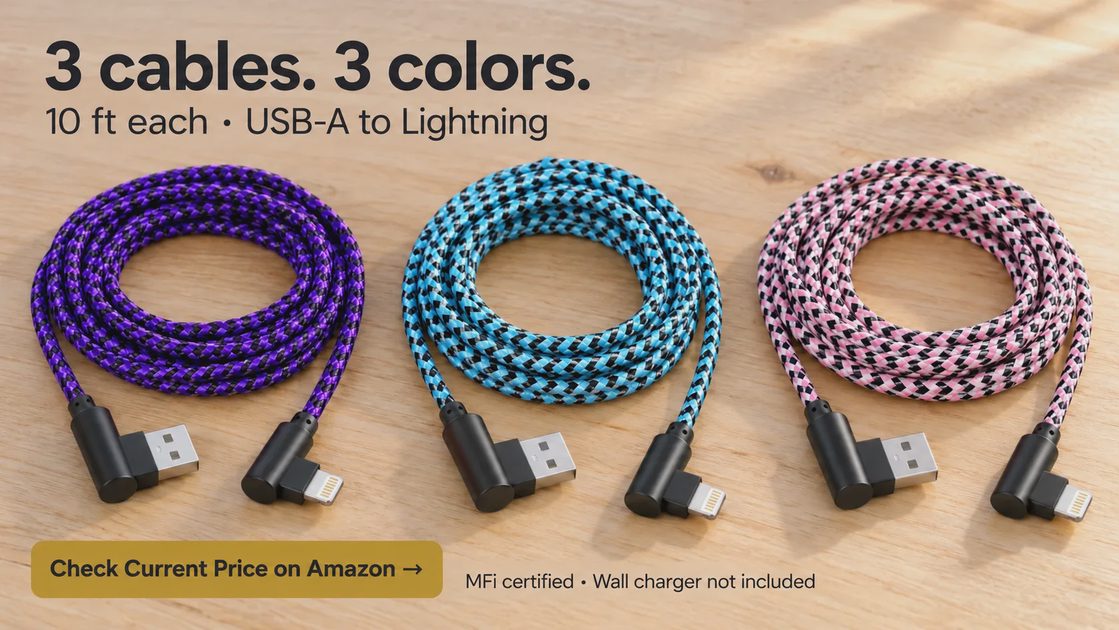
For the price of a couple of coffees you can put one by the bed, one in the living room, and keep one as a spare. That arithmetic is part of the product.
Where the 90 Degree 10ft iPhone Charger Actually Earns Its Place
The Ergonomics in Bed: Ending the "Pinky Shelf" Problem
Beyond protecting the wire itself, the more immediate difference shows up the moment you pick up the phone.
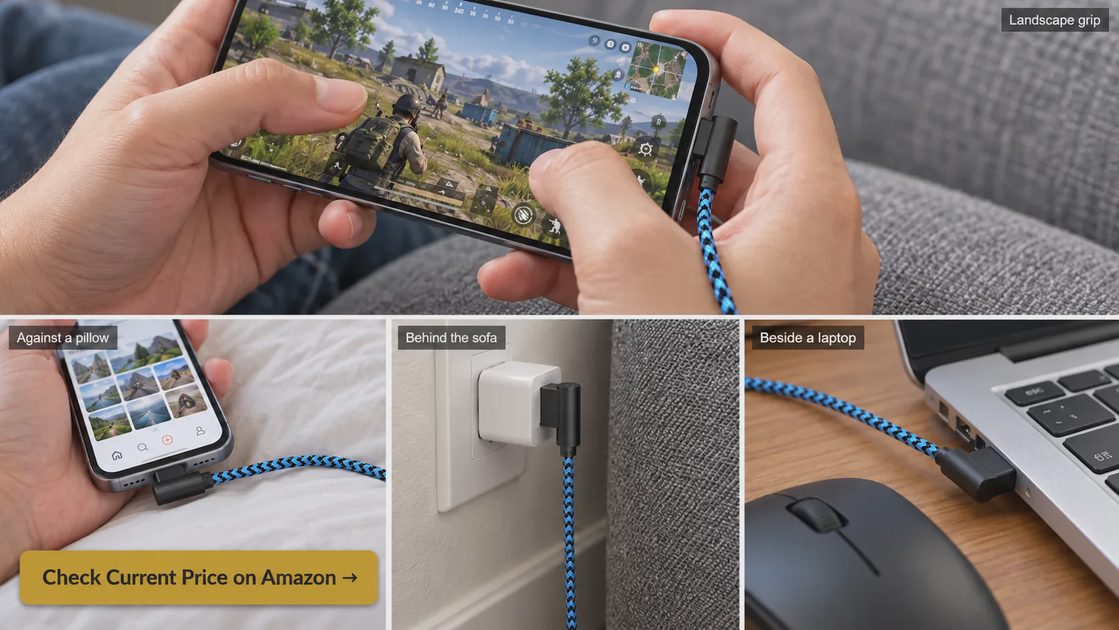
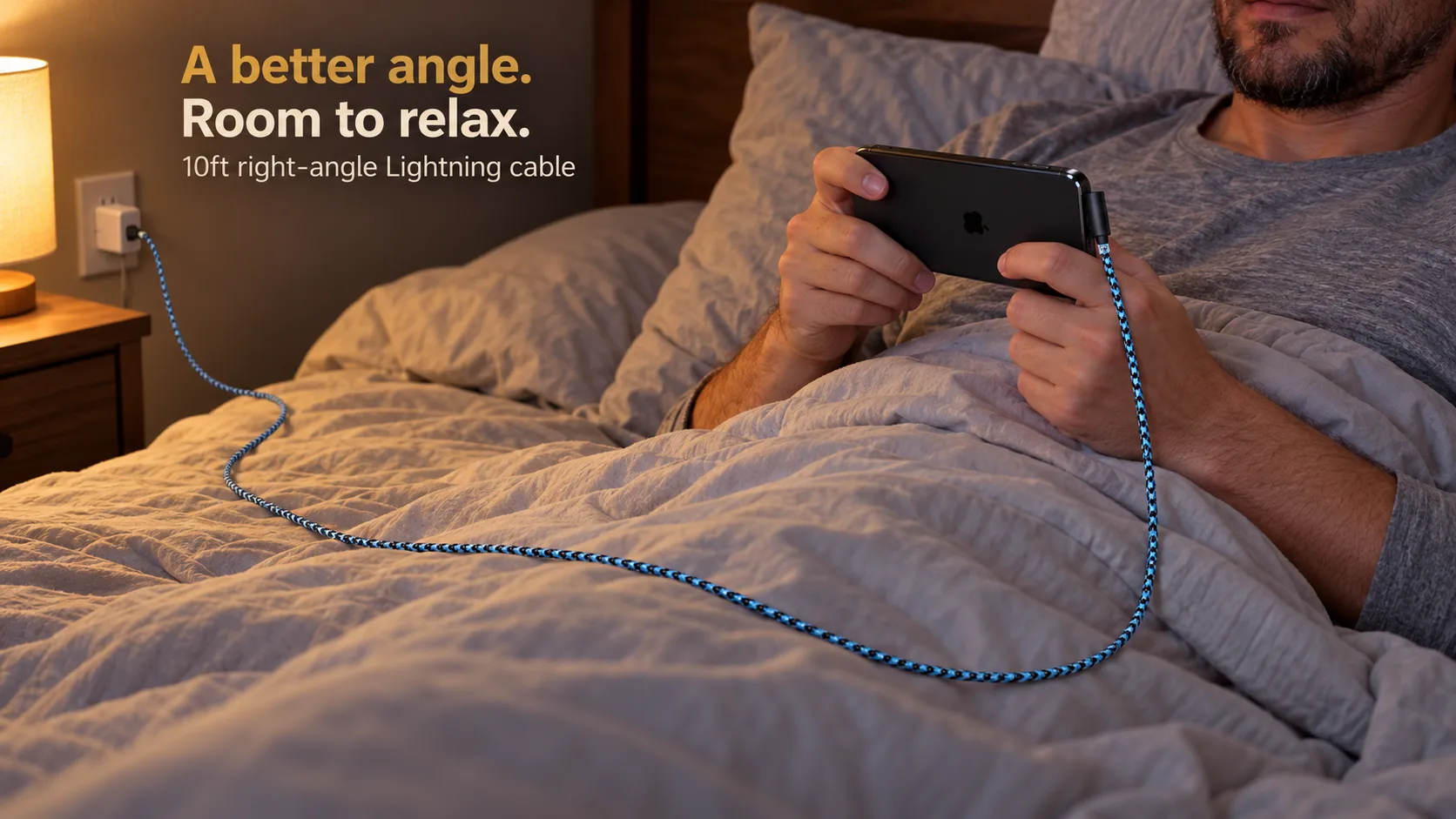
The moment you hold the phone horizontally to watch a video or play a game in bed, a straight plug becomes an ergonomic nuisance. The rigid connector lands squarely in the center of your palm, forcing your pinky finger into an awkward "shelf" position beneath the phone. Within minutes, hand fatigue sets in.
Position | Straight Cable | 90° Elbow Cable |
Landscape in bed | Connector digs into palm; fingers forced into awkward grip | Cable drops naturally along the hand; full, comfortable palm grip |
Side-lying one-handed | Plug constantly pokes into pillow or chest | Sits flush with the phone edge; fewer grip adjustments |
With the right-angle elbow, the low-profile plug hugs the edge of the chassis, allowing the braided cable to drop smoothly along the side of your hand. You can hold the phone naturally—almost as if it weren't plugged in at all—without shifting your grip every two minutes to dodge the connector. For anyone who winds down with their phone in bed, that tactile relief is noticeable on night one.
A 10ft iPhone Charger for Bed When the Outlet Is Behind the Nightstand
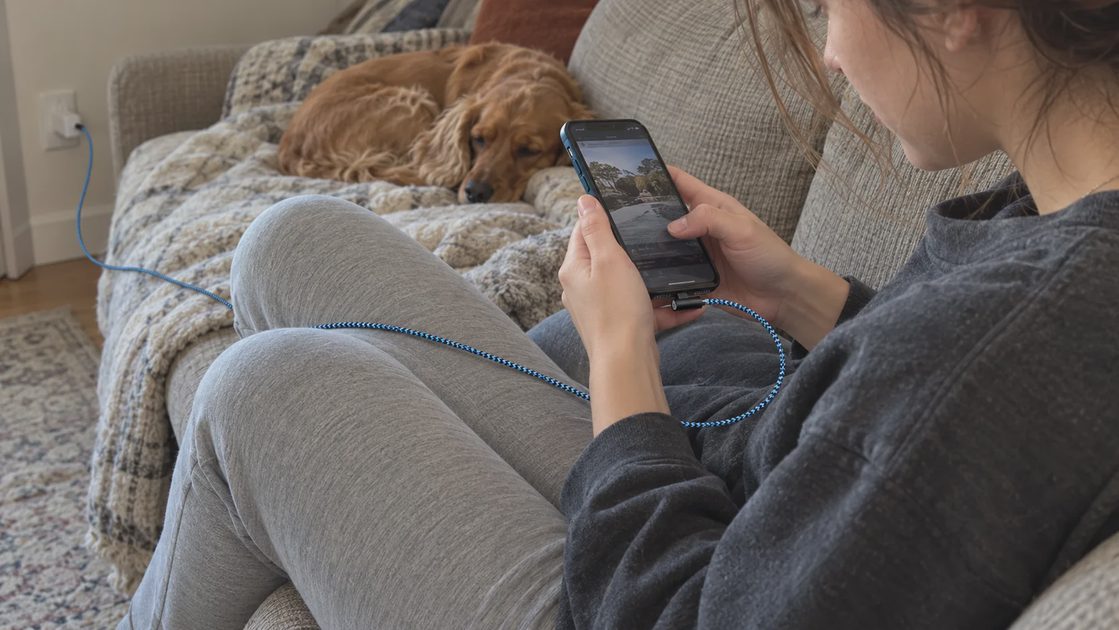
Ten feet is long enough to reach from a typical outlet behind a nightstand to the middle of a queen or king bed. You can roll over without the cable going tight. On a sofa the same length lets you sit in the middle cushion while the plug stays in the wall behind the arm.
For households where the convenient outlet is not next to the place you actually sit or lie, the extra length is the feature that gets used every day.
MFi Certification Still Matters for Lightning Cables
Cheap uncertified cables still produce the pop-up that says the accessory may not be supported. The message is minor, but it appears every time you plug in and it signals that the cable is outside Apple’s approved set.
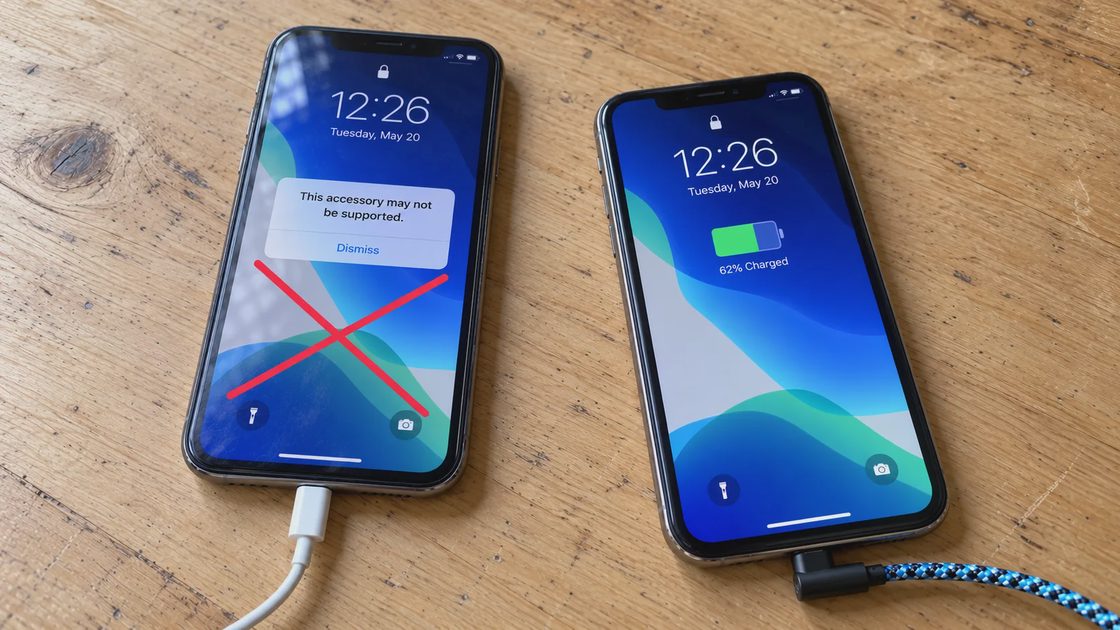
These cables do not trigger it. The connection behaves like any other MFi Lightning cable: it charges and syncs without the warning.
One fewer interruption and one fewer reason to wonder whether the cable is doing something undesirable to the battery.
For people who have already thrown away a couple of no-name cables because of the warning, the certification is a practical filter rather than a marketing claim.
Check Current Price on Amazon →
Durability and expected life
The nylon braid and right-angle design show clear practical advantages in ordinary bedside and sofa use:
The outer jacket is tighter and more resistant to tangling than the original plastic Apple cable, and it doesn’t develop the same greasy surface after weeks on a nightstand.
The manufacturer’s 15,000-bend and “twelve times stronger” claims come from lab tests; what I observed is simply that the cable stays cleaner and more intact under typical daily charging than a basic straight Lightning cable.
The Real Limits of This Fast Charging 10ft Lightning Cable
Charging speed
The listing and product images cite a maximum of 2.1 A or 2.4 A. That is the normal ceiling for a USB-A to Lightning cable. It is enough to top up a phone overnight or to keep the battery from falling while you use it on the couch. It is not the same as a USB-C Power Delivery charger that can push 20 W or more.
Note: These cables are better understood as all-day and overnight tools than as rapid top-up tools.
Who This iPhone Charger for Bed Is Actually For
This iPhone charger makes sense if you:
Still have Lightning devices
Regularly charge while lying down or sitting on a sofa
Have outlets that are not right beside the place you sit or lie
Want low-cost cables in more than one room and are willing to replace them when they eventually wear out
It makes less sense if you:
Need the fastest possible charge
Expect any single cable to last many years under heavy abuse
Have already moved your main devices to USB-C
Does This 90 Degree Lightning Cable Earn Its Place?
For the specific friction of charging in bed or on the couch, the combination of the right-angle connector, the ten-foot length, and the three-pack price does useful work. It removes the most common reasons a short straight cable becomes annoying, and it does so at a cost low enough that placing multiple cables around the house is practical.
It does not remove every limitation of Lightning cables, and it does not match the charging speed of current USB-C setups. Those are real boundaries.
Within the boundaries it was built for, the cable reduces a daily irritation without asking for much money or maintenance. That is enough for it to earn a place beside the bed and behind the sofa.
Check Current Price on Amazon →
Affiliate disclosure: This article contains affiliate links. If you purchase through these links, I may earn a commission at no additional cost to you. As an Amazon Associate I earn from qualifying purchases.